


Phang Nga Bay, located between Phuket Island and mainland southern Thailand is famous for its stunning limestone karsts and its unique cave system where travelers can paddle through the narrow, low hanging tunnels.
Phang Nga Bay caves developed over a very long period through a combination of limestone dissolution, changing water levels and coastal erosion. Natural rainwater and moving sea tides enter natural cracks in the rock to create passages at different levels while slightly acidic water slowly dissolves the limestone.

Table of Contents
The limestone foundation
Much of Phang Nga Bay is made from old limestone that started as carbonate material in ancient marine environments. Moreover, the sediment became solid rock and was lifted, fractured and exposed over time.
Limestone contains calcium carbonate, which reacts with weakly acidic water. This acidic water is created when rain absorbs carbon dioxide from the air and soil. Therefore, when this water enters joints and fractures; it dissolves tiny amounts of rock and gradually widens the pathways.
How sea caves grow
At the coastline, waves repeatedly compress air and water into cracks. Loose pieces are removed, and salt, sand and rock fragments add physical abrasion. Tides expose the same zone to alternating wet and dry conditions, helping small openings grow into larger sea caves.
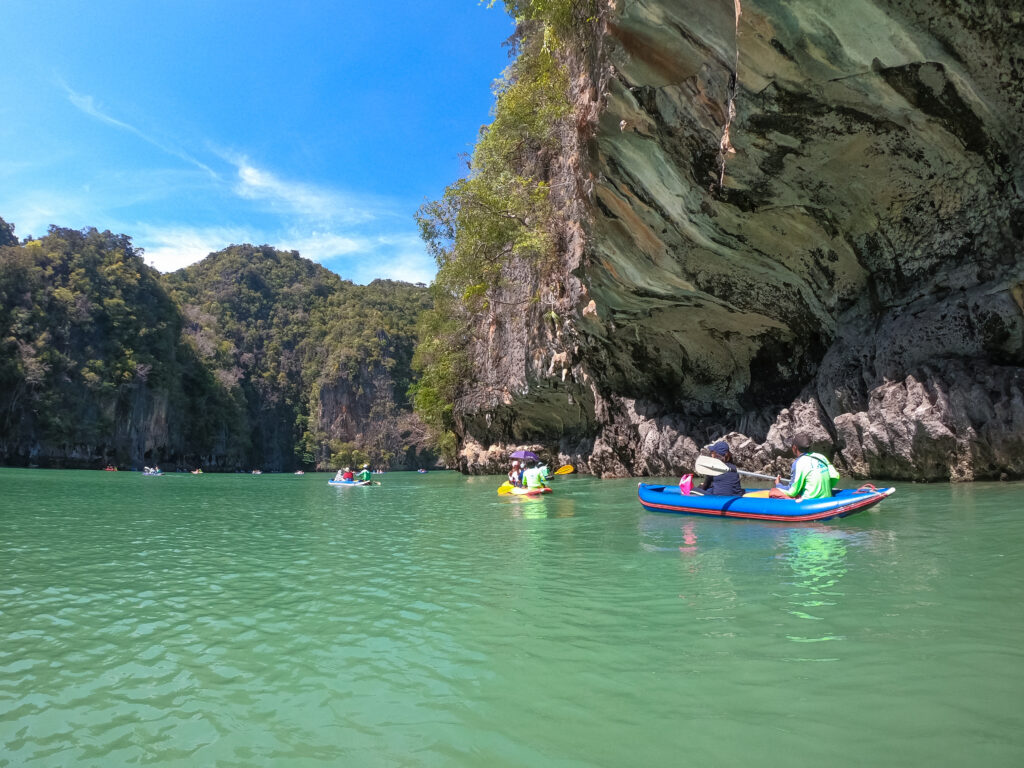
Not every cave forms at the same height due to the differing past sea levels and land geography. For example, a cave found above today’s waterline may have formed when the sea reached that level, while submerged passages may reflect another stage in the landscape’s history.
From caves to hidden hong lagoon
As dissolution continues, a cave system may expand behind the outer cliff. If part of the roof collapses, sunlight enters the enclosed space and plants can grow inside. As a result, hidden lagoon are surrounded by limestone walls, locally described as a hong, meaning a room or chamber.
Some hongs are reached through low tunnels that are accessible only around suitable tide levels. Therefore, canoe guides check the water before entering and may choose a different cave when the opening is too low, too shallow or affected by strong flow.
Exploring without damaging the caves
Love Andaman’s James Bond Island and Phang Nga Bay tour includes canoeing through selected caves and lagoons. Visitors should keep hands away from cave formations, remain seated when instructed and avoid scraping paddles against the walls. However, the route is never guaranteed since tide, weather, visitor traffic and park guidance determine access.
Frequently Asked Questions
What rock forms the Phang Nga Bay caves?
Most of the caves and towers are formed in limestone, a carbonate rock that can be dissolved by mildly acidic water.
How old is the limestone in Phang Nga Bay?
Some well-known limestone formations in the area date to the Permian period, hundreds of millions of years ago.
Do waves create the caves alone?
No. Chemical dissolution by rain and groundwater combines with wave erosion, tides, fractures and long-term sea-level change.
What is inside a Phang Nga Bay cave?
A cave may contain narrow tunnels, chambers, tidal pools, mangrove edges or an opening into a hidden hong lagoon.
Why are some cave entrances so low?
The opening formed near a particular erosion level, and the available space changes with the tide.
Can every cave be entered every day?
No. Guides choose caves according to tide, currents, waves, visitor traffic and official restrictions.
Can I touch cave formations?
It is best not to touch them. Oils, pressure and repeated contact can damage delicate surfaces and disturb cave life.